
Laboratory Quality
Assurance Testing
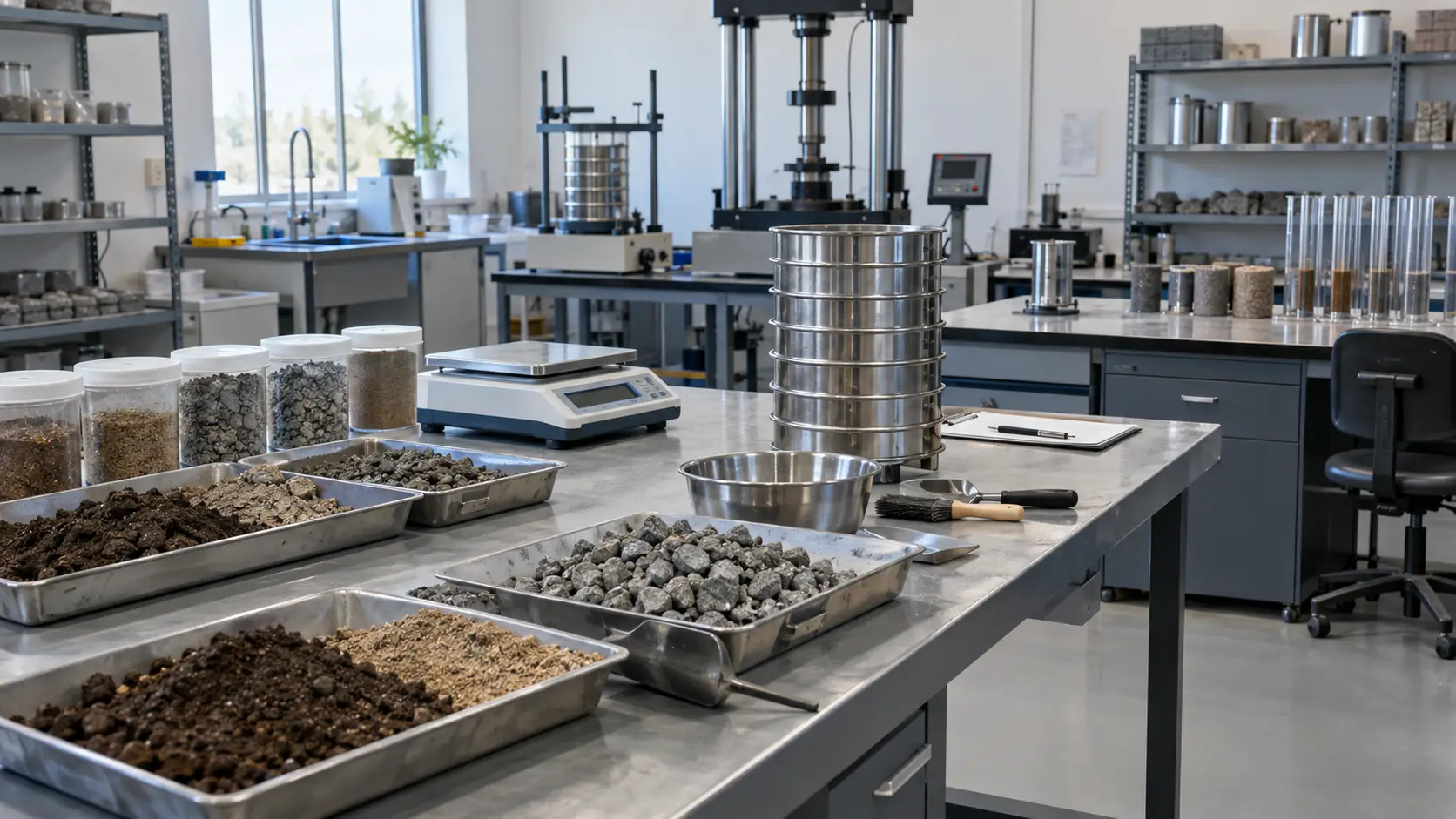
This information helps engineers and contractors determine whether a material is suitable for the proposed work, how it should be placed and what results must be achieved during field compaction testing.
Our laboratory provides quality assurance testing for earthworks, subdivisions, roads, building platforms, retaining structures and a wide range of civil construction projects.
By arranging laboratory testing early, project teams can reduce uncertainty, avoid unnecessary delays and ensure the correct information is available when construction begins.
Our Laboratory Services
Explore our specialist services, from planning and design through
to construction support and quality assurance.
Cohesive materials typically contain clay or silt particles that bind together. They are commonly encountered in natural ground and earthworks fill.
Granular materials are generally made up of sand, gravel or crushed aggregate. They are commonly used for road construction, drainage layers, building platforms and structural fill.
Many projects use both types of material. For example, a subdivision may involve cohesive earthworks during the initial site preparation, followed by granular materials during construction of roads and building platforms.
Each material behaves differently, which is why appropriate laboratory testing is required.
It also identifies the moisture content at which the material can be compacted most effectively.
This laboratory result provides the benchmark used during field compaction testing. On-site density results are compared against the laboratory maximum to calculate the percentage of compaction achieved.
This information supports other laboratory calculations and can be used alongside maximum dry density testing to better understand the behaviour and composition of the material.
Solid density testing may be completed on both cohesive and granular materials.
The material is separated into its different size ranges to show the balance of gravel, sand, silt and clay-sized particles.
This testing is primarily used for cohesive soils and the fine portion of some granular materials.
It helps identify the material’s plasticity and provides an indication of how it may behave during construction and under changing moisture conditions.
Material that is too wet or too dry may not achieve the required density, even when significant compactive effort is applied.
Laboratory moisture testing helps establish the condition of the sample and supports interpretation of other test results.
When combined with maximum dry density testing, it helps identify the optimum moisture range for successful compaction in the field.
Laboratory testing provides the information needed to determine whether basecourse, sub-base and other pavement materials comply with the relevant specification.
The laboratory first establishes the properties and compaction benchmark for the material. Field testing then measures the material after it has been placed and compacted on site.
Together, these results allow the project team to confirm whether the completed work meets the engineering specification.
Some tests take time to prepare, complete and report. Waiting until compaction testing is required can hold up earthworks or prevent the next construction stage from proceeding.
Where possible, proposed materials should be sampled and tested in advance. This gives the engineer and contractor time to confirm their suitability and establish the field testing requirements before work begins.
Contact us early to discuss the proposed materials, engineering specifications and testing programme so the required results are ready when construction begins.
Let’s Discuss Your Project
Every successful project starts with the right advice.
Whether you’re still exploring options or ready to begin construction, we’d be happy to discuss your requirements and recommend the most practical path forward.
Contact Civil Services (HB) Ltd today to speak with one of our experienced engineers or project specialists.